Everyone needs a little Magick in their life.
Everyone needs a little Magick in their life.
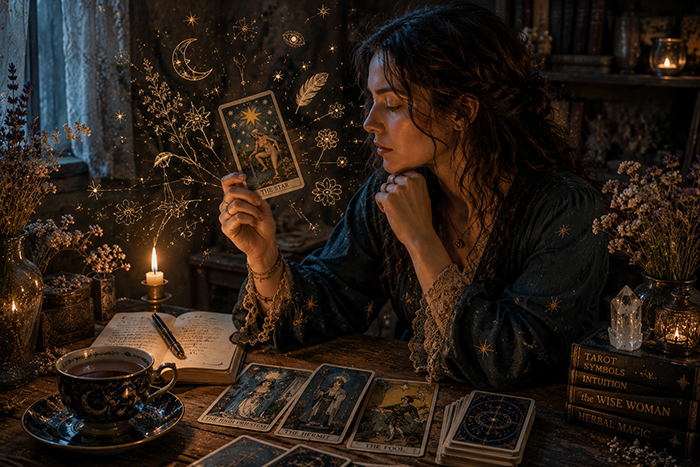
Have you ever wished the cards would simply tell you what they mean?
You lay them out carefully. You consult the guidebook. You stare at the artwork. And somehow, instead of clarity, you end up with even more questions!
Am I doing this right?
Am I intuitive enough?
Am I missing something obvious?
…If you’ve ever felt this way, I want you to know that you’re certainly not alone.
The truth is, most people aren’t really taught how tarot works.
They’re handed a deck and encouraged to memorise seventy-eight meanings, a ton of keywords, and perhaps a few spreads. While traditional interpretations absolutely have their place, tarot isn’t simply an exercise in getting the “right” answer.
Tarot is not a pop quiz or a test of how much you’ve managed to memorise. It’s a relationship. A conversation. Tarot is a way of listening.
A tarot reading invites us to pause for a moment and pay attention. To notice the symbols that catch our eye. To become curious about our emotional reactions. To explore the stories unfolding both within the cards and within our own lives…
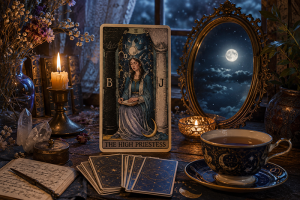 In many ways, this is the gift of The High Priestess.
She isn’t only a mysterious figure seated between worlds within the tarot. She also represents a part of ourselves: the quiet, observant, intuitive part that is willing to slow down and truly listen.
She is the part of us that notices. Reflective, thoughtful. The part of us that can sit with uncertainty long enough for understanding to emerge.
The beautiful thing is that you don’t need to be born psychic to access that part of yourself.
And to use tarot, you don’t need to memorise every card before you begin. You don’t need years of experience. You simply need curiosity. A willingness to trust what you notice. And the courage to ask, “What might this card be trying to show me?”
Whether you’re brand new to tarot or returning to the cards after years away, this guide is designed to help you move beyond memorisation and into something much more meaningful.
Together, we’ll explore what tarot really is, the biggest mistakes beginners make, how to read like The High Priestess, and practical ways to strengthen your confidence and intuition along the way.
So light a candle. Pour a cup of your favourite tea. Shuffle your cards… and lets’ begin.
One of the biggest misconceptions about tarot is that it’s all about predicting the future.
Ask a question. Pull a card. Receive an absolute answer.
While some readers certainly work with tarot in predictive ways, many witches discover that the cards are most powerful when used as a tool for reflection, clarity, and guidance.
Tarot can help us recognise patterns we may not have noticed before. It can highlight blind spots, validate what we already know deep down, and encourage us to explore situations from a different perspective.
Sometimes, it confirms what your intuition has been whispering all along. At other times, it gently challenges the stories you’ve been telling yourself.
But here is what tarot does not do:
Instead, tarot invites you into a conversation.
Imagine sitting down with a wise friend. Not one who tells you exactly what to do, but one who asks thoughtful questions. One who notices things you may have overlooked. One who encourages you to become curious rather than fearful.
That’s often what tarot feels like at its best.
And perhaps this is where The High Priestess appears once again.
As beginners, we often want certainty. We want to know whether we’ve interpreted the cards “correctly”. We want reassurance that we’re getting it right.
The High Priestess reminds us that understanding doesn’t always arrive all at once.
In fact, it often unfolds slowly. Piece by piece. It may be a symbol catches your attention. Or a sentence from the guidebook that lingers in your mind.
A card’s meaning deepens as your life experience gives it new context.
Reading tarot isn’t about having all the answers immediately. It’s about learning to ask better questions.
Questions like:
• What am I not seeing clearly here?
• What energy surrounds this situation?
• What wisdom would support me right now?
• What pattern might I be repeating?
• What is this experience inviting me to learn?
When we approach tarot this way, something shifts. The pressure to perform begins to dissipate. We no longer feel the need to be perfect readers. We simply become attentive ones. Curious. Present. Willing to listen.
And perhaps that is the real secret of tarot: not predicting the future, but learning how to pay attention to the wisdom already unfolding within and around us. The High Priestess teaches us that understanding rarely arrives all at once. More often, it reveals itself piece by piece, to those willing to pause, observe, and listen.
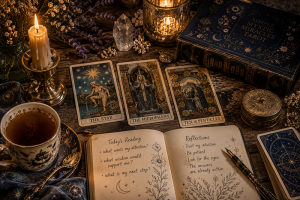 How To Read Tarot Like The High Priestess
So, you’ve shuffled your cards, asked your question, and turned over the first card.
Now what?
For many beginners, this is the moment panic sets in.
You rack your brain trying to remember meanings. You flip frantically through the guidebook. You wonder if you should pull another card because perhaps you’ve somehow “missed” the message.
The High Priestess invites another approach…
She doesn’t rush. She notices. She reflects. She allows meaning to emerge.
Before reaching for the guidebook, take a moment to simply sit with the card in front of you. Imagine you’re looking at a piece of art or stepping into the pages of a storybook.
Then, ask yourself these four simple questions:
1. What story is unfolding?
Look at the card as if you’ve never seen it before.
Who is in the image?
What are they doing?
What seems to have happened just before this moment?
What might happen next?
For example, The Hermit may not simply mean “introspection”. You might notice an elder carrying a lantern through the darkness. Someone searching. Someone trusting the wisdom they’ve gathered through experience.
Tarot often speaks through story before it speaks through definitions.
2. What symbols stand out to me?
You don’t need to understand every traditional correspondence to work with symbolism.
Notice what naturally catches your attention… A lantern. A moon. A crown. A river. A butterfly. A garden in bloom.
Ask yourself: Why this symbol? What does it mean to me?
Over time, you’ll begin developing your own relationship with the language of the cards.
3. How do I feel when I look at this card?
This question is one of the most overlooked… and one of the most powerful.
Do you feel hopeful? Uneasy? Comforted? Inspired? Annoyed? Relieved?
Your emotional response doesn’t replace traditional meanings, but it adds another layer of understanding. Sometimes the card’s message lies not only in what it represents, but in how it asks you to respond.
4. What do I already know?
Before assuming the cards are revealing something entirely new, pause and ask: “How does this connect to my life right now?”
What situations immediately come to mind? What truth have you perhaps been avoiding? What part of you quietly says, “I already know exactly what this is about”?
Tarot can certainly surprise us! But very often, it illuminates wisdom that already exists beneath the surface.
The more you practice these four questions, the more confident you’ll become. These four questions invite you to move beyond memorisation and into relationship. The more you ask them, the more naturally tarot begins to speak in its own language.
You’ll stop worrying so much about getting everything “right.” Instead, you’ll begin building a relationship with the cards. One rooted in curiosity, attention, and trust.
And perhaps that’s what reading like The High Priestess truly means: not having all the answers, but learning to slow down, pay attention, and trust what you notice before rushing to certainty.
If you’re new to tarot, chances are you’ve already made at least one of these mistakes.
Please know this: every tarot reader has!
These little missteps aren’t signs that you’re “bad” at tarot. In fact, they’re often just part of the learning process. The trick is simply recognising them so that they don’t undermine your confidence or leave you feeling more confused than when you started.
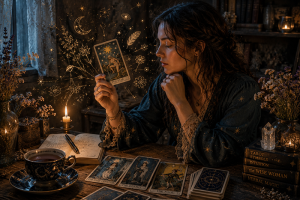
1. Trying to Memorise Everything
Seventy-eight cards. Upright meanings. Reversed meanings. Elemental correspondences. Astrological associations…
It’s enough to make anyone’s head spin.
While study certainly has its place, you don’t need to memorise every possible meaning before you begin reading.
Afterall, the High Priestess doesn’t sit exams. She observes. She notices. She trusts that understanding deepens over time.
Start by looking at the card in front of you. Notice the story, the symbols, and your own reactions. The traditional meanings will become richer and more meaningful through experience.
2. Asking “Closed” Questions
“Will I get the job?”
“Does this person love me?”
“Will everything work out?”
These questions aren’t wrong, but they often lead us to seek certainty where curiosity might serve us better. Instead, try asking:
• What do I need to know about this opportunity?
• What energy surrounds this relationship?
• How can I best navigate this situation?
• What wisdom would support me right now?
Open-ended questions invite deeper, more nuanced guidance.
3. Pulling Card After Card Until You Get the Answer You Want
We’ve all been there!
You pull a card. You don’t like it. So you pull another. And another. And perhaps another after that, hoping one of them will finally tell you what you wanted to hear in the first place.
Sometimes, more cards don’t create more clarity. They simply create more confusion. If a message feels uncomfortable, sit with it before reaching for clarification. Ask yourself:
“What part of this am I resisting?”
Very often, the first card has more wisdom than we initially realise.
4. Assuming Every Card Is Literal
Pulling the Death card doesn’t mean someone is about to die. The Devil doesn’t mean you’re cursed. The Tower doesn’t guarantee disaster.
Tarot speaks in archetypes, metaphors, and symbols.
Death can represent transformation. The Devil may point toward unhealthy attachments or limiting beliefs. The Tower can signify revelation, liberation, and necessary change.
Approach the cards with curiosity rather than fear. Ask yourself what the card might symbolise within the context of your question and your life.
5. Forgetting That You Matter Too
Guidebooks are wonderful teachers. Traditional meanings offer valuable foundations. But you are part of the reading as well.
Your experiences, instincts, emotional responses, and the images that draw your attention are part of the reading. Tarot is a relationship between the cards, the question, and the person sitting before them.
You don’t have to choose between intuition and tradition. Both have something valuable to offer.
And perhaps this is one final lesson from The High Priestess. She reminds us that wisdom isn’t found solely in books, nor solely in instinct. It lives in the conversation between knowledge and experience.
Like any relationship, reading tarot deepens with time. The more you practice, the more confidence you’ll gain. Not because you’ll finally know everything there is to know about tarot. But because you’ll begin to trust yourself enough to sit with the cards, ask thoughtful questions, and listen for what they have to say.
Have you ever shuffled your deck, pulled a card… and thought:
“Oh. You again.”
Many tarot readers affectionately refer to these as “stalker cards”. These are cards that seem determined to follow us from reading to reading, flat out refusing to be ignored.
Perhaps it’s The Hermit popping up every time you ask about your next steps. The Tower showing up whenever you avoid making a difficult decision. Or The High Priestess herself quietly appearing, inviting you to trust the wisdom you’ve held within you all along.
While it can feel mysterious (and sometimes a little unnerving!), repeating cards are actually quite common.
Before assuming something terrible is about to happen, take a breath and become curious.
Ask yourself:
• What was I asking about when this card appeared?
• What themes or situations are repeating in my life right now?
• Is there a message I’ve been dismissing or avoiding?
• How have my circumstances changed since I first pulled this card?
• What might this card be inviting me to pay attention to?
Sometimes, a repeating card is less about prediction and more about emphasis. Think of it as a teacher gently repeating an important lesson. Or a friend smiling across the table and asking: “Have you really considered all of your options?”
The High Priestess reminds us that wisdom doesn’t always arrive through dramatic revelations. Often, it comes through repetition. A message reveals itself slowly, one small piece at a time. The same feeling. The same symbol. The same quiet nudge appearing again and again until we’re ready to receive it.
If you find yourself working with a stalker card, consider spending a little extra time with it.
Journal about it. Meditate with it. Place it somewhere you’ll see it throughout the day. Pull it out before your daily reading and ask what new layer of meaning it might have for you today.
You don’t need to force an answer. You don’t need to figure it all out immediately. Sometimes, simply paying attention is enough.
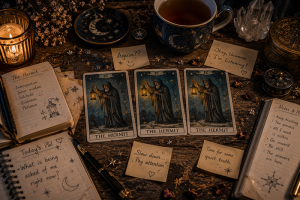 The Everyday Rituals of Tarot Readers
One of the most beautiful things about tarot is that it doesn’t have to be complicated.
You don’t need an elaborate altar, dozens of tarot books, or hours of uninterrupted time. In fact, many tarot readers deepen their relationship with the cards through small, simple rituals woven gently into everyday life.
Like any relationship, your connection with the cards strengthens through consistency rather than perfection.
A few minutes here and there can be just as meaningful as a full moon ritual.
If you’d like to deepen your confidence and intuition, here are a few everyday rituals you might like to try:
Pull a Card for the Day
This is perhaps one of the simplest and most powerful tarot practices of all.
Each morning, ask: “What energy, lesson, or opportunity might support me today?”
Spend a few moments observing the card before reaching for the guidebook. Notice the story unfolding within the image. The symbols that stand out. The emotions it stirs within you.
Then, at the end of the day, reflect on how its message appeared in your life.
You may be surprised by how often the cards make perfect sense in hindsight.
Keep a Tarot Journal
You don’t need pages of elaborate notes or beautifully decorated spreads. Simply record:
Over time, your journal becomes more than a collection of readings. It becomes a record of your relationship with the cards.
You’ll begin to notice patterns, recurring themes, and how your understanding deepens with experience, over time.
Spend Time with Difficult Cards
Most tarot readers have cards they’d rather not see. Perhaps it’s Death. The Tower. The Devil.
Instead of immediately fearing them, consider getting to know them. Pull them out of the deck and spend a little time in their company. Journal about them. Meditate with them. Ask: “What are you trying to teach me?”
Very often, the cards we resist most strongly become some of our greatest teachers.
Create a Simple Reading Ritual
The High Priestess reminds us that wisdom often reveals itself in moments of pause.
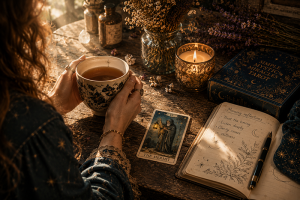
Before a reading, you might choose to light a candle, brew a cup of tea, take a few slow breaths, or spend a moment grounding yourself.
Not because tarot requires elaborate ceremony, but because these small rituals help us transition from the busyness of everyday life into a space of reflection and receptivity.
They remind us that this conversation matters.
Tarot doesn’t ask us to be perfect. It simply invites us to return. A card pulled over morning coffee. A journal entry before bed. A candle flickering beside a difficult question. These small, everyday rituals have a way of weaving themselves into something sacred.
And before long, you may realise that tarot has become more than something you occasionally do…
Rather, it has become a trusted companion. A steady source of reflection, insight, and wonder, waiting patiently for you to sit down and begin the conversation once again.
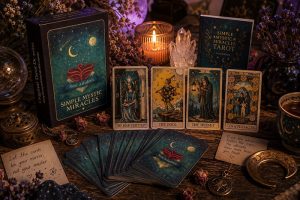 Meet Rose Ariadne’s “Simple Mystic Miracles” Tarot Deck
If you’ve been part of the Simple Mystic Miracles family for a little while, you may have noticed that we’ve been rather busy behind the scenes…
And at long last, we can finally share what we’ve been working on.
After many months of dreaming, creating, refining, second-guessing, celebrating, and pouring our hearts into every detail, Rose Ariadne’s Simple Mystic Miracles Tarot Deck has arrived.
To say we’re excited would be an understatement!
This deck has truly been a labour of love.
Created in the spirit of the Rider-Waite-Smith tradition, the Simple Mystic Miracles Tarot was designed to be both beautiful and approachable. A deck that welcomes complete beginners, while offering plenty of depth for seasoned readers.
A deck that doesn’t expect perfection, but rather invites curiosity. A deck that encourages you to pause, notice, reflect, and trust what you’re discovering along the way.
Filled with sacred symbols, moonlit blues, antique golds, candlelit rituals, and storybook figures, each card offers an opportunity to slow down and ask: “What might this be trying to show me?”
Perhaps that’s what we love most about it. It doesn’t demand that you have all the answers. It simply invites you into the conversation. To sit with the cards. To ask the questions resting on your heart. To return, again and again, to the quiet wisdom that lives both within the cards and within yourself.
We have a feeling this deck is going to become a treasured companion for many years to come.
And truly, we couldn’t be more delighted to finally place it in your hands.
If you’d like to explore Rose Ariadne’s Simple Mystic Miracles Tarot Deck for yourself, you can learn more here: https://store.simplemysticmiracles.com
Before we part ways, I’d love to leave you with a simple tarot spread you can return to whenever you’re seeking clarity, reassurance, or a little gentle guidance.
Remember, you don’t need to have all the answers before you begin. Simply shuffle your cards, take a few slow breaths, and ask:
“What message is meant for me right now?”
Then lay out three cards:
Card One: What wants my attention?
What energy, situation, feeling, or truth is asking to be acknowledged?
What might The High Priestess be gently inviting you to notice?
Card Two: What wisdom would support me?
What guidance, perspective, or lesson would help you navigate this season of life with greater clarity?
Card Three: What is my next step?
Not your entire five-year plan. Not the complete map. Just the next small, meaningful step you can take from here.
Witch Tips: Spend a few moments with each card before reaching for the guidebook. Notice the story unfolding. The symbols that catch your eye. The emotions they stir within you. Ask yourself: “What do I already know to be true?”
And remember…
Tarot isn’t about getting everything right. It’s about cultivating a relationship. A conversation. A willingness to listen. To be patient.
Trust what you notice.
If there’s one thing tarot has taught me over the years, it’s this: the messages meant for you have the most beautiful way of finding you.
If there’s one thing I hope you take away from this guide, let it be this:
You do not need to know everything to read tarot. You do not need to have every card memorised. You do not need to consider yourself especially psychic, intuitive, or gifted.
You simply need a willingness to listen. To pause before rushing to certainty. To notice the symbol that catches your eye. To pay attention to the feeling rising in your chest. To become curious about the stories unfolding within the cards and within your own life.
Perhaps this is the true gift of The High Priestess.
A reminder that wisdom rarely arrives all at once. More often, it reveals itself slowly. In symbols. In synchronicities. In questions bravely asked. In cards drawn over morning tea. And in the quiet voice within that says:
“Pay attention. There is something here for you.”
Tarot won’t remove every uncertainty from your life. But it may help you meet uncertainty with greater trust. Greater curiosity. And greater compassion for yourself.
So light a candle. Shuffle your cards. Ask the question resting on your heart.
Then listen.
The conversation is already unfolding.
And perhaps, you’ll discover that the wisdom you’ve been seeking hasn’t been hiding from you at all.



Walking The Ancestor Road: How To Build A Living Relationship With Your Ancestors
blog.simplemysticmiracles.com
Discover how to connect with your ancestors through simple rituals, meaningful offerings, and ancestor altars. Honor your loved ones and seek spiritual guidance.
Walking The Ancestor Road: How To Build A Living Relationship With Your Ancestors
blog.simplemysticmiracles.com
Discover how to connect with your ancestors through simple rituals, meaningful offerings, and ancestor altars. Honor your loved ones and seek spiritual guidance.